Moving Beyond the English Translation with the Boho Biblical Word Study Template
For many who approach the Bible, the English translation feels like the final destination. Yet anyone who has lingered over a passage senses something deeper—a weight, a texture, a layered meaning that modern language cannot fully capture. The difference between reading a verse and studying a word in its original language is the difference between looking at a photograph of a landscape and standing in the middle of it. The Boho Biblical Word Study Template was designed to bridge that gap, offering a structured yet flexible framework for serious exegesis without requiring a seminary degree.
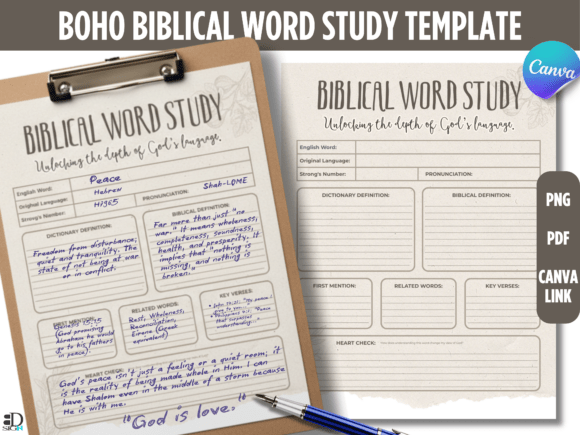
This is not a generic journal page meant to collect dust. It is a practical tool built around the core disciplines of biblical language study: original language identification, pronunciation, Strong’s numbering, lexical versus biblical definitions, first mention contexts, word families, and heart-level application. Whether you are a homeschooling parent building a curriculum, a KDP seller creating interior content, or a seminary student refining your hermeneutics, this layout provides a repeatable process that turns shallow reading into deep understanding.
The Architecture of Deeper Study: Original Language and Strong’s Integration
At the heart of any serious word study lies the original language. The Boho Biblical Word Study Template dedicates an entire section to the identity of a word: its Hebrew or Greek spelling, its pronunciation, and its Strong’s number. This might seem technical at first, but Strong’s numbers unlock the treasure house of concordances, lexicons, and interlinear Bibles. By recording the number alongside the word, you create a reference point that allows you to trace the same term across every occurrence in Scripture—a method that reveals patterns invisible in translation.
Consider the Hebrew word chesed. English Bibles render it as “lovingkindness,” “mercy,” or “steadfast love,” depending on the translator’s preference. Each choice carries a slightly different nuance, but none of them capture the covenantal loyalty embedded in the original. By landing on the Strong’s number (H2617) and seeing the word in its Hebrew form, you move from interpretation to observation. You are no longer at the mercy of the translator’s choice; you are seeing the raw material for yourself.
This feature is especially valuable for creators who produce Bible study journals for KDP. A template that includes original language fields signals to buyers that the product offers more than surface-level reflection. It positions the journal as a serious study aid, appealing to Christians who want to move beyond devotional reading into exegetical work.
Pronunciation and Phonetic Memory
Pronunciation might seem secondary, but speaking a word aloud creates a different kind of connection. When you vocalize logos or ruach, you engage auditory memory alongside visual and kinesthetic learning. The Boho Biblical Word Study Template includes a dedicated pronunciation line for this exact reason. It is not about perfecting ancient accents; it is about making the word feel familiar, as if it belongs in your mouth and not just on the page.
The Contrast: Dictionary Definition Versus Biblical Definition
One of the most illuminating features of this layout is the side-by-side comparison between a dictionary definition and a biblical definition. Modern dictionaries define words based on contemporary usage, which often reflects secular or generalized meanings. A biblical definition, on the other hand, emerges from the original context, the cultural setting, and the word’s usage across the canon.
Take the word “righteousness.” A standard dictionary might say “morally right or justifiable.” But the biblical definition, rooted in the Hebrew tsedeq, carries the idea of right relationship, covenant faithfulness, and communal restoration. It is not merely an ethical category; it is a relational one. By placing these two definitions side by side, the template forces you to confront the gap between world meaning and God meaning. That tension is where real learning happens.
- World Meaning: What the culture assumes the word means.
- Biblical Meaning: What the text demonstrates the word means across its usage.
- Contrast Insight: The difference reveals assumptions you bring to the text that may obscure its original intent.
This contrast section serves anyone who teaches or writes about Scripture. For homeschool educators, it provides a ready-made discussion prompt. For seminary students, it clarifies interpretive choices. For content creators, it becomes a unique selling point—a feature that generic journals do not offer.
First Mention and Related Words: Building a Semantic Network
Words accumulate meaning over time, especially in Scripture. The first occurrence of a word often sets a theological trajectory that echoes throughout the rest of the Bible. The Boho Biblical Word Study Template includes a field for first mention, allowing you to return to the original context where a word was introduced. This is not merely trivia; it is a hermeneutical anchor. When you study the word “grace” in the New Testament, understanding its first mention in the Old Testament (often tied to favor and unmerited kindness) deepens your appreciation of Pauline theology.
Equally important is the section for related words or synonyms. Language does not exist in isolation. A word like “faith” (pistis in Greek) connects to “believe” (pisteuo), “trust” (peitho), and “faithfulness” (pistos). By mapping these semantic links, you begin to see the Bible as a web of interlocking concepts rather than a collection of independent verses. This approach benefits anyone who preaches, teaches, or writes Bible studies because it prevents proof-texting and encourages holistic interpretation.
Practical Use for Curriculum Developers
For those creating homeschool Bible curricula, the related words section is a goldmine. It allows you to build thematic units around word families. Instead of teaching a single verse, you can guide students through a network of passages that illuminate a concept from multiple angles. The Boho Biblical Word Study Template becomes a repeatable worksheet that can be used week after week, book after book.
The Heart Check: Application That Leads to Transformation
Knowledge without application is information, not formation. The final section of this template—the Heart Check—is designed to prevent study from becoming an intellectual exercise. It asks the user to consider how the word moves from the page into daily life. This is not a space for generic prayers or vague resolutions. It is a structured prompt that connects exegesis to discipleship.
For example, after studying the Greek word makrothumia (long-suffering, patience), the Heart Check might ask: “Where in your current relationships are you tempted to react instead of endure? How does the biblical definition of patience reshape your response?” This transforms the study from a passive reading into an active confrontation with the Spirit.
For KDP sellers, this feature differentiates your product from the hundreds of generic study journals on Amazon. Customers are looking for tools that produce results—not just pages to fill, but frameworks that change how they engage with Scripture. The Heart Check answers that need.
Who Benefits from This Template?
The Boho Biblical Word Study Template is not limited to one audience. Its design accommodates multiple use cases, each with distinct needs:
- Seminary Students: Need a repeatable method for exegesis papers, sermon preparation, and language practice. The Strong’s number integration and definition contrast save hours of cross-referencing.
- Homeschool Educators: Require tools that teach students how to study, not just what to memorize. The template builds critical thinking skills by forcing comparison and contextual analysis.
- KDP Sellers and Content Creators: Look for interior designs that justify a premium price point. The advanced fields (first mention, related words, Strong’s numbers) signal depth and differentiate their products from competitors.
- Lay Christians and Small Group Leaders: Want structure without rigidity. The Boho aesthetic keeps the template inviting, while the academic features provide substance for serious discussion.
Commercial Opportunities with the Boho Biblical Word Study Template
For entrepreneurs in the Christian publishing space, this template offers immediate commercial utility. The package includes a Canva template link, allowing you to edit, rebrand, and resell as your own. You can change fonts, adjust colors, translate the text, or integrate your logo. The high-resolution PDF and transparent PNG files make it ready for print-on-demand platforms or digital distribution.
Consider the following niche ideas for KDP interiors:
- Deep-dive Bible study journals focused on individual books (Romans, Psalms, Hebrews)
- Thematic word studies (grace, faith, covenant, kingdom)
- Homeschool vocabulary builders that combine biblical language with English composition
- Undated daily or weekly study planners for personal devotion
- Supplementary workbooks for Bible college courses
Because the template is fully editable, you can create multiple variations without starting from scratch. Adjust the layout for different trim sizes, add or remove sections, or combine multiple templates into a longer journal. The commercial license gives you the freedom to treat the template as a foundation rather than a finished product.
Considerations for Effective Use
While the Boho Biblical Word Study Template is comprehensive, it functions best when used with additional tools. A good concordance (digital or print), an interlinear Bible, and a lexicon (such as Strong’s or Thayer’s) will enhance the study experience. The template does not replace these resources; it organizes the information they provide.
Users should also be aware of the learning curve. For someone unfamiliar with Strong’s numbers or original languages, the first few studies may feel slow. That is normal. The template is designed to build competence over time. Each field encourages a specific skill: looking up a number, comparing definitions, tracing a word’s first occurrence. After several uses, these actions become second nature.
For educators, consider modeling the template with a class before asking students to use it independently. Walk through each field together, explaining why it matters and how to find the information. Once students internalize the process, the template becomes a tool they can use for a lifetime.
Why This Layout Matters for Exegesis
Exegesis—the critical explanation of a text—requires discipline. It is easy to read a verse and immediately jump to application, skipping the hard work of observation and interpretation. The Boho Biblical Word Study Template enforces exegetical discipline by breaking the process into manageable steps. You cannot fill out the template without asking foundational questions: What language was this written in? What does this word mean in its original context? How does its first use inform its later use? What does the word family reveal? How does this change my life?
That sequence mirrors the exegetical method taught in seminaries: observation, interpretation, correlation, application. By embedding this structure into a beautiful, printable format, the template makes academic methods accessible to everyday readers. It democratizes biblical scholarship without dumbing it down.
In a world of shallow content and quick answers, tools that reward attention and curiosity are rare. The Boho Biblical Word Study Template is one of those tools. Whether you are creating content for others or deepening your own walk with Scripture, it offers a proven path from the surface to the depths—one word at a time.